Tender
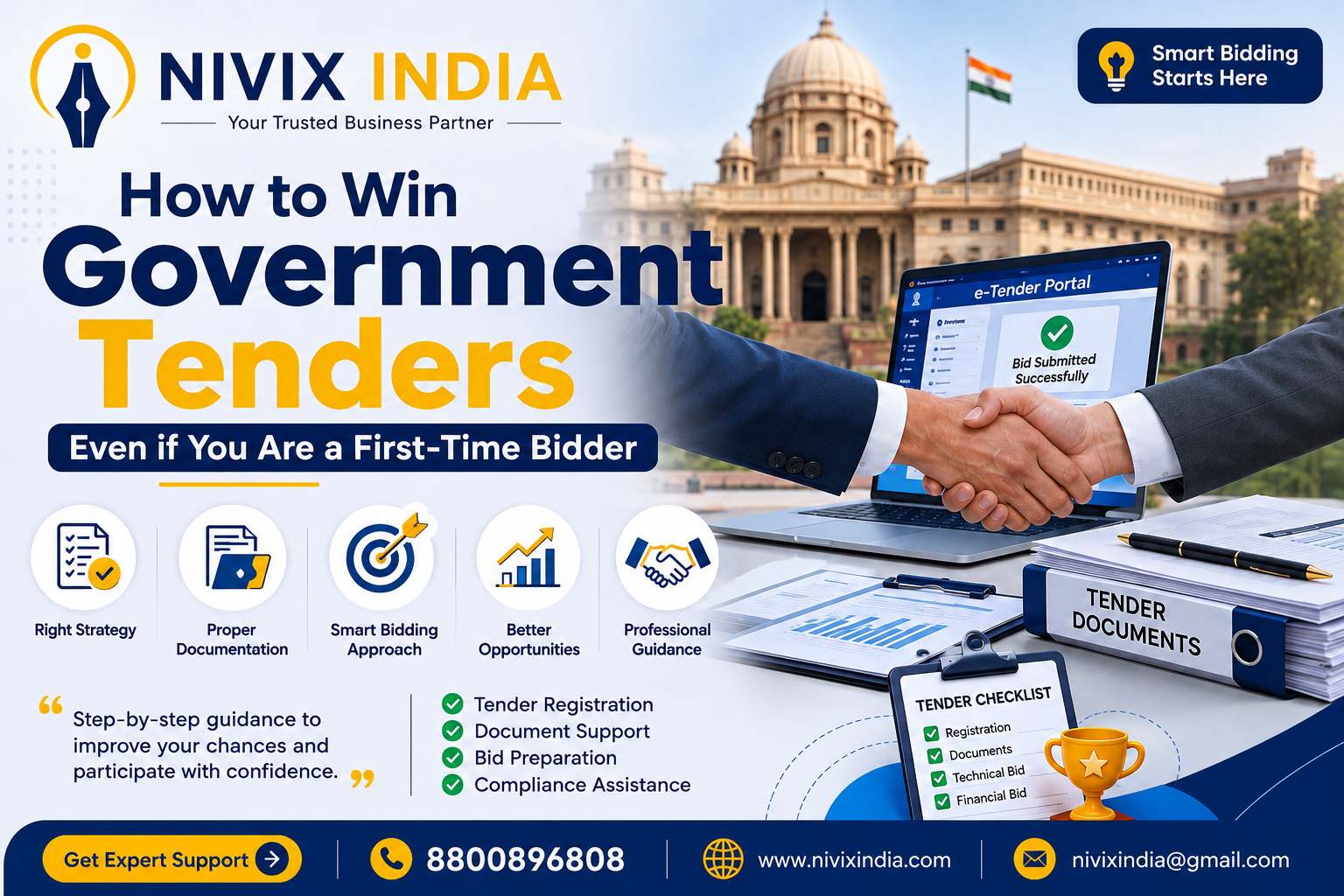
How to Win Government Tenders Even if You Are a First-Time Bidder
Government tenders offer excellent business opportunities for MSMEs, startups, contractors, suppliers, and service providers. Every year, thousands of tenders are published by Central Government departments, State Governments, PSUs, Railways, Defence organizations, Municipal Corporations, and many other public authorities.
At Nivix India, we help businesses understand the complete tender participation process, documentation requirements, vendor registrations, and bid preparation. While no one can guarantee a tender award, proper guidance significantly improves the quality of your bid submission.
1. Register on the Right Tender Portals
The first step is registering on government procurement portals such as:
• GeM (Government e-Marketplace)
• CPP Portal
• IREPS (Railway Tenders)
• State Government e-Tender Portals
• PSU Procurement Portals
2. Keep Your Business Documents Ready
Before participating in any tender, maintain updated documents such as:
• PAN Card
• GST Registration
• UDYAM/MSME Certificate
• Company Incorporation Certificate
• Partnership Deed or Proprietorship Proof
• Digital Signature Certificate (DSC)
• Bank Details
• Cancelled Cheque
• Address Proof
• Income Tax Returns (if applicable
3. Read the Tender Document Carefully
Many bidders lose opportunities because they skip important conditions.
Always check:
• Eligibility criteria
• Technical specifications
• Turnover requirement
• Experience requirement
• EMD details
• Important dates
• Bid submission process
• Required certificates
4. Choose Tenders That Match Your Business
Do not bid for every available tender i.e:
• Your products or services
• Financial capability
• Available manpower
• Delivery capacity
• Technical qualifications
5. Obtain a Valid Digital Signature Certificate (DSC)
• Most government e-tender portals require a valid Class 3 Digital Signature Certificate for online submission.
• Without a DSC, you cannot submit bids on most procurement portals.
6. Prepare Technical and Financial Bids Carefully Government tenders generally contain two parts:
Technical Bid
Includes documents proving your eligibility.
Financial Bid
Contains your commercial quotation.
Ensure both are complete, accurate, and uploaded in the correct format before the deadline.
7. Never Miss Submission Deadlines
Tender portals automatically close once the submission time ends.
Always upload documents early:
• Internet issues
• DSC errors
• File size problems
• Portal traffic
8. Monitor Corrigendum and Tender Updates Government departments may revise:
• Specifications
• Submission dates
• Eligibility conditions
• BOQ
• Important instructions
9. Build Your Experience Gradually
If you are a first-time bidder, begin with smaller tenders.
Successfully completing smaller government projects helps build:
• Work experience
• Performance certificates
• Client references
• Business credibility
Common Mistakes First-Time Bidders Should Avoid
• Uploading incomplete documents
• Ignoring eligibility conditions
• Wrong file formats
• Last-minute submission
• Incorrect pricing
• Missing mandatory declarations
• Not reading corrigendum’s
• Using an expired DSC
Avoiding these mistakes can significantly improve your bid quality.
How Nivix India Supports Tender Participants
Nivix India provides professional assistance for businesses looking to participate in government tenders by helping with:
• Tender identification
• Vendor Registration
• GeM Registration
• Railway Tender Support
• Document Verification
• Technical Documentation Guidance
• Bid Preparation Assistance
• Compliance Support
Our objective is to simplify the tender participation process while ensuring that businesses understand the applicable requirements. We do not promise or guarantee tender approval or contract awards, as the final decision always rests with the concerned government authority.
Conclusion
Winning a government tender is possible even for first-time bidders when they prepare properly, understand tender requirements, maintain complete documentation, and submit accurate bids on time. Success in government procurement depends on compliance, careful planning, and continuous learning rather than experience alone.
If you're planning to enter government contracting, taking the right guidance from the beginning can make the bidding process smoother and more efficient.
1. Register on the Right Tender Portals
The first step is registering on government procurement portals such as:
• GeM (Government e-Marketplace)
• CPP Portal
• IREPS (Railway Tenders)
• State Government e-Tender Portals
• PSU Procurement Portals
2. Keep Your Business Documents Ready
Before participating in any tender, maintain updated documents such as:
• PAN Card
• GST Registration
• UDYAM/MSME Certificate
• Company Incorporation Certificate
• Partnership Deed or Proprietorship Proof
• Digital Signature Certificate (DSC)
• Bank Details
• Cancelled Cheque
• Address Proof
• Income Tax Returns (if applicable
3. Read the Tender Document Carefully
Many bidders lose opportunities because they skip important conditions.
Always check:
• Eligibility criteria
• Technical specifications
• Turnover requirement
• Experience requirement
• EMD details
• Important dates
• Bid submission process
• Required certificates
4. Choose Tenders That Match Your Business
Do not bid for every available tender i.e:
• Your products or services
• Financial capability
• Available manpower
• Delivery capacity
• Technical qualifications
5. Obtain a Valid Digital Signature Certificate (DSC)
• Most government e-tender portals require a valid Class 3 Digital Signature Certificate for online submission.
• Without a DSC, you cannot submit bids on most procurement portals.
6. Prepare Technical and Financial Bids Carefully Government tenders generally contain two parts:
Technical Bid
Includes documents proving your eligibility.
Financial Bid
Contains your commercial quotation.
Ensure both are complete, accurate, and uploaded in the correct format before the deadline.
7. Never Miss Submission Deadlines
Tender portals automatically close once the submission time ends.
Always upload documents early:
• Internet issues
• DSC errors
• File size problems
• Portal traffic
8. Monitor Corrigendum and Tender Updates Government departments may revise:
• Specifications
• Submission dates
• Eligibility conditions
• BOQ
• Important instructions
9. Build Your Experience Gradually
If you are a first-time bidder, begin with smaller tenders.
Successfully completing smaller government projects helps build:
• Work experience
• Performance certificates
• Client references
• Business credibility
Common Mistakes First-Time Bidders Should Avoid
• Uploading incomplete documents
• Ignoring eligibility conditions
• Wrong file formats
• Last-minute submission
• Incorrect pricing
• Missing mandatory declarations
• Not reading corrigendum’s
• Using an expired DSC
Avoiding these mistakes can significantly improve your bid quality.
How Nivix India Supports Tender Participants
Nivix India provides professional assistance for businesses looking to participate in government tenders by helping with:
• Tender identification
• Vendor Registration
• GeM Registration
• Railway Tender Support
• Document Verification
• Technical Documentation Guidance
• Bid Preparation Assistance
• Compliance Support
Our objective is to simplify the tender participation process while ensuring that businesses understand the applicable requirements. We do not promise or guarantee tender approval or contract awards, as the final decision always rests with the concerned government authority.
Conclusion
Winning a government tender is possible even for first-time bidders when they prepare properly, understand tender requirements, maintain complete documentation, and submit accurate bids on time. Success in government procurement depends on compliance, careful planning, and continuous learning rather than experience alone.
If you're planning to enter government contracting, taking the right guidance from the beginning can make the bidding process smoother and more efficient.
