DUAC Clears Revised Plan for Pranab Mukherjee Samadhi at Rajghat: Revised Memorial Proposal Gets Approval
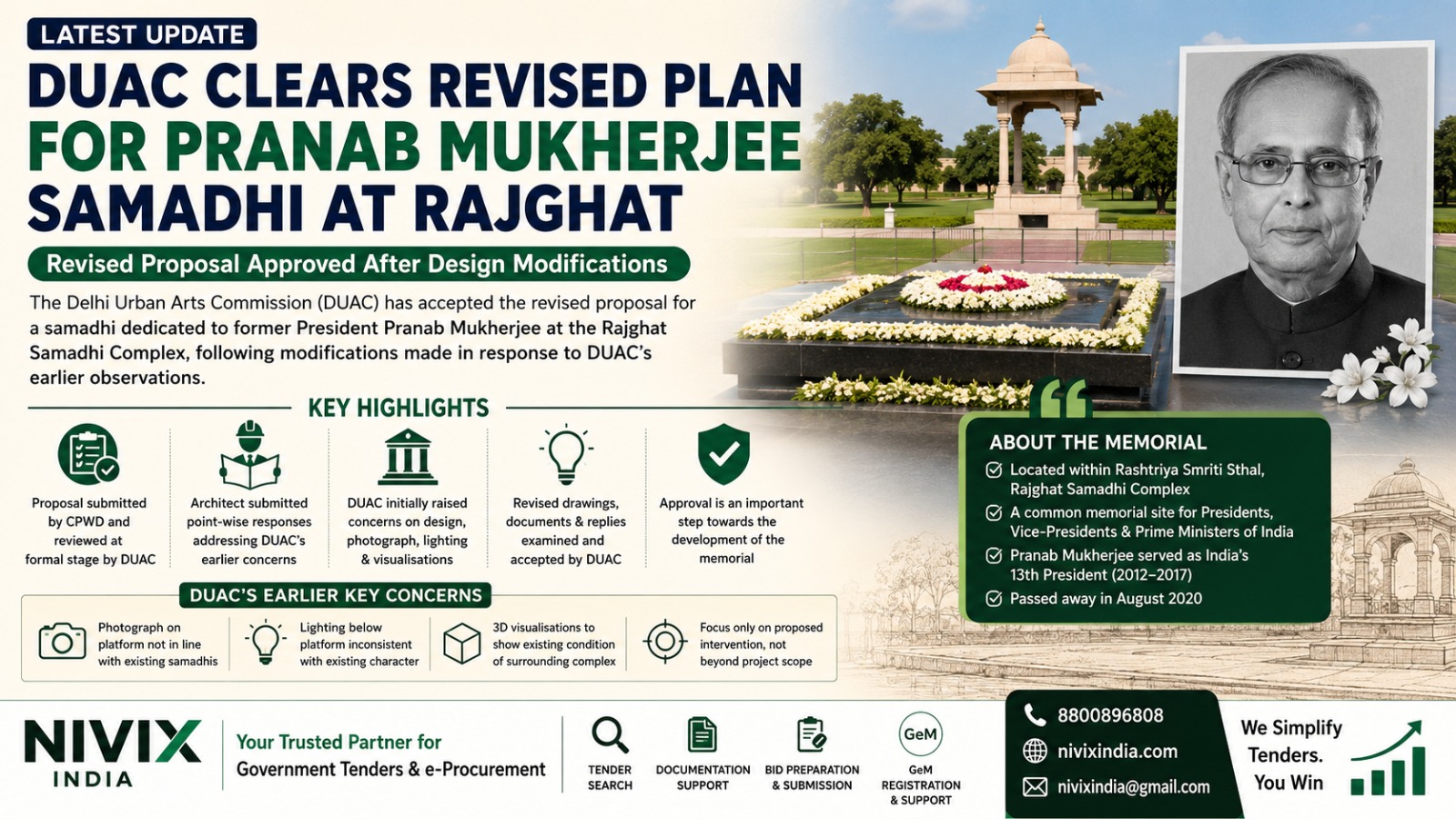
New Delhi: The Delhi Urban Arts Commission (DUAC) has approved the revised proposal for a memorial dedicated to former President Pranab Mukherjee at the Rajghat Samadhi Complex in New Delhi. The revised plan was accepted after the project team addressed several design-related observations raised by the commission during its earlier review.
The proposal has been submitted by the Central Public Works Department (CPWD) and relates to the development of a samadhi within Rashtriya Smriti Sthal, the designated memorial area for former Presidents, Vice-Presidents and Prime Ministers of India.
The latest approval is an important step toward the development of the memorial while also underlining the importance of architectural sensitivity, visual consistency and respect for the existing character of the Rajghat memorial landscape.
For companies working in construction, architecture, infrastructure development and government contracting, such projects also highlight the role of CPWD tenders, government procurement, public infrastructure projects and specialised consultancy services. Nivix India helps businesses understand and participate in government tender opportunities through professional tender consultancy and bid support services.
DUAC Approves Revised Pranab Mukherjee Memorial Proposal
The revised proposal for the Pranab Mukherjee Samadhi at Rajghat was considered by the Delhi Urban Arts Commission after the architect and project team submitted point-by-point responses to the concerns raised in the earlier review.
DUAC had previously examined the project and made several observations related to the design, presentation and visual relationship of the proposed memorial with the existing samadhis within the complex.
After these concerns were addressed through revised drawings, documentation and design modifications, the commission found the updated proposal acceptable.
This approval allows the project to move forward to the next stages, subject to the remaining administrative, technical and execution-related requirements.
Where Will the Pranab Mukherjee Samadhi Be Located?
The proposed memorial is planned within Rashtriya Smriti Sthal, which forms part of the broader Rajghat memorial precinct in New Delhi.
The site has been developed as a common memorial space for distinguished national leaders, including former Presidents, Vice-Presidents and Prime Ministers.
Former President Pranab Mukherjee passed away in August 2020. He served as the 13th President of India from 2012 to 2017 and had a long political and administrative career spanning several decades.
The proposed memorial is therefore expected to become an important addition to the national memorial landscape.
However, because the Rajghat area has a strong historical, architectural and symbolic identity, any new development needs to maintain continuity with the visual character of the existing memorials.
What Concerns Had DUAC Raised Earlier?
DUAC had initially considered the proposal during its meeting in May 2026.
At that stage, the commission raised several observations regarding the design of the memorial and its relationship with the surrounding landscape.
One of the primary concerns related to the proposed installation of a photograph of former President Pranab Mukherjee on a granite platform.
The commission observed that existing samadhis within the memorial complex generally do not use photographs in this manner.
As a result, the project team was advised to explore an alternative approach that would preserve the dignity and visual consistency of the Rajghat memorial environment.
This recommendation reflected DUAC’s broader responsibility to ensure that new urban and architectural interventions remain compatible with important public spaces.
Lighting Design Was Also Reviewed
Another design element reviewed by DUAC was the proposed lighting below the square memorial platform.
The commission reportedly felt that this feature might not align with the understated and restrained visual language of the existing memorial complex.
Rajghat and Rashtriya Smriti Sthal are characterised by relatively simple and dignified architectural expressions.
Therefore, the use of decorative or visually dominant lighting needed to be carefully reconsidered.
The revised proposal was expected to address these concerns and ensure that lighting remained functional without disturbing the overall solemn character of the site.
DUAC Raised Issues With 3D Visualisations
In addition to physical design elements, DUAC also reviewed how the project had been presented through architectural drawings and 3D visualisations.
The commission asked the project team to represent the surrounding memorial complex in its actual existing condition.
It also advised that the visual presentation should remain focused on the proposed memorial intervention rather than showing elements beyond the actual scope of the project.
This is particularly important in architectural approval processes because visualisations can influence how a project is understood by reviewing authorities.
Accurate site representation helps authorities assess issues such as scale, proportion, landscape integration and contextual compatibility.
Revised Drawings and Responses Submitted
Following DUAC’s earlier observations, the architect and project team prepared a revised proposal.
The updated submission included revised drawings, supporting documents, photographs and point-wise responses addressing the commission’s concerns.
DUAC examined the revised material and subsequently accepted the proposal.
This indicates that the updated design was considered sufficiently aligned with the expectations of the commission regarding visual restraint, contextual sensitivity and architectural compatibility.
The approval represents an important administrative milestone, although further stages related to project execution, procurement, contracting and construction may still be required.
Role of CPWD in the Project
The proposal has been submitted by the Central Public Works Department (CPWD), one of India’s major government construction and infrastructure agencies.
CPWD is responsible for the planning, construction and maintenance of a wide range of government buildings and infrastructure assets.
Its projects include government offices, institutional buildings, housing, public infrastructure, heritage-related developments and other important civil works.
Projects such as the Pranab Mukherjee memorial may involve several disciplines, including:
• Architectural planning
• Civil construction
• Structural engineering
• Landscaping
• Electrical works
• Lighting systems
• Stone and finishing works
• Drainage and utilities
• Security infrastructure
• Maintenance planning
Depending on the execution model, various components of such government projects may be awarded through separate contracts and tenders.
Why DUAC Approval Matters in Delhi Projects
The Delhi Urban Arts Commission plays an important role in reviewing major urban development and architectural proposals in the national capital.
Its responsibilities include examining the visual and architectural quality of projects and ensuring that developments contribute positively to Delhi’s urban environment.
For projects located near historically, culturally or nationally important locations, this review becomes even more significant.
A memorial complex such as Rajghat requires a particularly sensitive approach because new construction must respect the existing architectural language and symbolic importance of the site.
DUAC’s review therefore goes beyond routine building approval and focuses heavily on design quality, urban context and visual impact.
Importance of Context-Sensitive Architecture
The approval of the revised memorial proposal highlights a broader principle in public architecture: new construction should respond to its context.
When a project is being developed within an established heritage or memorial environment, designers cannot treat the site like an isolated plot.
They must consider existing materials, landscape character, building scale, visual axes, pedestrian movement and the symbolic significance of surrounding structures.
In the Rajghat complex, simplicity and restraint form an important part of the overall experience.
Therefore, new memorial elements need to complement rather than compete with the existing environment.
The revised Pranab Mukherjee memorial proposal appears to have been evaluated with these principles in mind.
What Happens After DUAC Approval?
DUAC clearance is an important stage, but it does not necessarily mean that construction will begin immediately.
Depending on the project structure, several steps may follow.
These can include technical approvals, detailed engineering, cost estimates, administrative sanctions, budget approvals, tendering, contractor selection and project execution.
For government construction projects, the procurement stage is especially important because contractors and suppliers are typically selected through formal government tendering processes.
This creates opportunities for eligible contractors, infrastructure companies, material suppliers and service providers.
Government Tender Opportunities in CPWD Projects
CPWD regularly issues tenders for civil works, electrical works, repair and maintenance projects, landscaping, specialised construction, consultancy and supply-related requirements.
Companies interested in working with CPWD need to carefully monitor relevant tender opportunities and ensure that they meet the required eligibility criteria.
Government tenders may include requirements related to:
• Previous work experience
• Annual turnover
• Similar project completion
• Technical qualifications
• Contractor registration
• EMD or bid security
• Performance guarantee
• GST registration
• PAN
• Digital signature certificate
• Financial documentation
• Work completion certificates
• Technical manpower
The exact requirements vary from one tender to another.
For this reason, bidders should always review the complete tender document before submitting a bid.
Why Professional Tender Consultancy Can Help
Government tender documentation can be complex, especially for companies entering public procurement for the first time.
Even experienced contractors can face challenges when preparing technical documents, checking eligibility conditions, uploading bids or responding to tender requirements.
A small documentation error can sometimes lead to disqualification even when the bidder is technically capable of executing the project.
Professional Tender Consultancy Services can help businesses understand the tender conditions and prepare their submissions more systematically.
Consultancy support can be useful for areas such as:
• Tender search
• Eligibility checking
• Tender document analysis
• Technical bid preparation
• Financial bid support
• Document compilation
• GeM registration
• e-Tendering assistance
• Bid submission support
• Government procurement guidance
How Nivix India Supports Government Tender Bidders
Nivix India provides tender consultancy services to contractors, suppliers, manufacturers and service providers interested in participating in government procurement opportunities.
The objective is to help businesses understand tender requirements and organise their bidding process more efficiently.
Nivix India can assist with areas such as Government Tender Consultancy, GeM Tender Support, e-Tendering, Tender Search, Tender Documentation and Bid Preparation.
For infrastructure-related businesses, regular monitoring of CPWD, PWD and other government construction tenders can help identify suitable opportunities.
However, every company should evaluate its own eligibility, technical capability and financial requirements before participating in any tender.
Opportunities for Infrastructure Companies
Major government projects often create opportunities across the construction ecosystem.
A memorial project, for example, may require services from multiple categories of vendors and contractors.
These can include civil contractors, electrical contractors, architectural consultants, landscaping agencies, stone suppliers, lighting specialists, security system providers and maintenance contractors.
Large public infrastructure agencies may tender these requirements either through a main EPC-style contract or through multiple specialised packages.
Businesses operating in these sectors should therefore monitor government e-procurement platforms and official departmental tender portals.
Importance of Bid Preparation
Winning a government tender is not simply about quoting the lowest price.
Bidders must satisfy all technical and administrative requirements.
A properly prepared bid should include accurate documents, valid registrations, correct certificates and all information requested in the tender.
Before submitting a government bid, companies should check whether:
• All eligibility criteria are satisfied
• Required certificates are valid
• Financial documents are updated
• Experience certificates match tender conditions
• EMD requirements are correctly fulfilled
• Digital signatures are active
• Bid forms are properly completed
• Technical documents are uploaded in the required format
• Submission deadlines are followed
Missing even one mandatory document can create problems during technical evaluation.
What the Pranab Mukherjee Memorial Approval Signifies
The approval of the revised Pranab Mukherjee Samadhi plan reflects the careful approach required for development within nationally important memorial spaces.
It also shows how major public projects often pass through several rounds of design review before receiving approval.
The modifications suggested by DUAC were focused on ensuring that the proposed memorial remained consistent with the visual and architectural character of Rajghat.
This approach helps protect the dignity of the site while allowing new memorials to be incorporated appropriately.
A Balance Between Modern Development and Heritage Character
Government infrastructure projects in historically important locations require a balance between modern functionality and heritage sensitivity.
Design authorities must ensure that new interventions do not overpower the original character of the location.
The revised memorial project demonstrates how architectural proposals can evolve through review and consultation.
Changes in lighting, visual presentation, memorial elements and landscaping can significantly influence how a project integrates with its surroundings.
Such reviews are particularly important in national memorial spaces where architectural decisions have long-term cultural significance.
Conclusion
The Delhi Urban Arts Commission’s approval of the revised plan for the Pranab Mukherjee Samadhi at Rajghat marks an important milestone in the development of the memorial.
The proposal, submitted by CPWD, was revised after DUAC raised concerns regarding the design of the memorial platform, use of photographs, lighting and project visualisations.
Following the submission of updated drawings and point-wise responses, the commission found the proposal acceptable.
The clearance demonstrates the importance of maintaining architectural restraint and contextual sensitivity within nationally significant memorial sites such as Rajghat.
For the construction and infrastructure industry, the project also reflects the broader opportunities created by government development works.
Companies interested in participating in CPWD Tender, PWD Tender, Government Construction Tender, GeM Bid or e-Procurement opportunities should regularly monitor relevant government procurement portals and maintain complete documentation.
Nivix India supports businesses with professional government tender consultancy, documentation and bidding assistance to help simplify the tender participation process.
Contact Nivix India
Looking for assistance with Government Tender, CPWD Tender, PWD Tender, GeM Registration, e-Tendering or Bid Documentation?
Nivix India
Phone: 8800896808
Website: nivixindia.com
Email: nivixindia@gmail.com
New Delhi: The Delhi Urban Arts Commission (DUAC) has approved the revised proposal for a memorial dedicated to former President Pranab Mukherjee at the Rajghat Samadhi Complex in New Delhi. The revised plan was accepted after the project team addressed several design-related observations raised by the commission during its earlier review.
The proposal has been submitted by the Central Public Works Department (CPWD) and relates to the development of a samadhi within Rashtriya Smriti Sthal, the designated memorial area for former Presidents, Vice-Presidents and Prime Ministers of India.
The latest approval is an important step toward the development of the memorial while also underlining the importance of architectural sensitivity, visual consistency and respect for the existing character of the Rajghat memorial landscape.
For companies working in construction, architecture, infrastructure development and government contracting, such projects also highlight the role of CPWD tenders, government procurement, public infrastructure projects and specialised consultancy services. Nivix India helps businesses understand and participate in government tender opportunities through professional tender consultancy and bid support services.
DUAC Approves Revised Pranab Mukherjee Memorial Proposal
The revised proposal for the Pranab Mukherjee Samadhi at Rajghat was considered by the Delhi Urban Arts Commission after the architect and project team submitted point-by-point responses to the concerns raised in the earlier review.
DUAC had previously examined the project and made several observations related to the design, presentation and visual relationship of the proposed memorial with the existing samadhis within the complex.
After these concerns were addressed through revised drawings, documentation and design modifications, the commission found the updated proposal acceptable.
This approval allows the project to move forward to the next stages, subject to the remaining administrative, technical and execution-related requirements.
Where Will the Pranab Mukherjee Samadhi Be Located?
The proposed memorial is planned within Rashtriya Smriti Sthal, which forms part of the broader Rajghat memorial precinct in New Delhi.
The site has been developed as a common memorial space for distinguished national leaders, including former Presidents, Vice-Presidents and Prime Ministers.
Former President Pranab Mukherjee passed away in August 2020. He served as the 13th President of India from 2012 to 2017 and had a long political and administrative career spanning several decades.
The proposed memorial is therefore expected to become an important addition to the national memorial landscape.
However, because the Rajghat area has a strong historical, architectural and symbolic identity, any new development needs to maintain continuity with the visual character of the existing memorials.
What Concerns Had DUAC Raised Earlier?
DUAC had initially considered the proposal during its meeting in May 2026.
At that stage, the commission raised several observations regarding the design of the memorial and its relationship with the surrounding landscape.
One of the primary concerns related to the proposed installation of a photograph of former President Pranab Mukherjee on a granite platform.
The commission observed that existing samadhis within the memorial complex generally do not use photographs in this manner.
As a result, the project team was advised to explore an alternative approach that would preserve the dignity and visual consistency of the Rajghat memorial environment.
This recommendation reflected DUAC’s broader responsibility to ensure that new urban and architectural interventions remain compatible with important public spaces.
Lighting Design Was Also Reviewed
Another design element reviewed by DUAC was the proposed lighting below the square memorial platform.
The commission reportedly felt that this feature might not align with the understated and restrained visual language of the existing memorial complex.
Rajghat and Rashtriya Smriti Sthal are characterised by relatively simple and dignified architectural expressions.
Therefore, the use of decorative or visually dominant lighting needed to be carefully reconsidered.
The revised proposal was expected to address these concerns and ensure that lighting remained functional without disturbing the overall solemn character of the site.
DUAC Raised Issues With 3D Visualisations
In addition to physical design elements, DUAC also reviewed how the project had been presented through architectural drawings and 3D visualisations.
The commission asked the project team to represent the surrounding memorial complex in its actual existing condition.
It also advised that the visual presentation should remain focused on the proposed memorial intervention rather than showing elements beyond the actual scope of the project.
This is particularly important in architectural approval processes because visualisations can influence how a project is understood by reviewing authorities.
Accurate site representation helps authorities assess issues such as scale, proportion, landscape integration and contextual compatibility.
Revised Drawings and Responses Submitted
Following DUAC’s earlier observations, the architect and project team prepared a revised proposal.
The updated submission included revised drawings, supporting documents, photographs and point-wise responses addressing the commission’s concerns.
DUAC examined the revised material and subsequently accepted the proposal.
This indicates that the updated design was considered sufficiently aligned with the expectations of the commission regarding visual restraint, contextual sensitivity and architectural compatibility.
The approval represents an important administrative milestone, although further stages related to project execution, procurement, contracting and construction may still be required.
Role of CPWD in the Project
The proposal has been submitted by the Central Public Works Department (CPWD), one of India’s major government construction and infrastructure agencies.
CPWD is responsible for the planning, construction and maintenance of a wide range of government buildings and infrastructure assets.
Its projects include government offices, institutional buildings, housing, public infrastructure, heritage-related developments and other important civil works.
Projects such as the Pranab Mukherjee memorial may involve several disciplines, including:
• Architectural planning
• Civil construction
• Structural engineering
• Landscaping
• Electrical works
• Lighting systems
• Stone and finishing works
• Drainage and utilities
• Security infrastructure
• Maintenance planning
Depending on the execution model, various components of such government projects may be awarded through separate contracts and tenders.
Why DUAC Approval Matters in Delhi Projects
The Delhi Urban Arts Commission plays an important role in reviewing major urban development and architectural proposals in the national capital.
Its responsibilities include examining the visual and architectural quality of projects and ensuring that developments contribute positively to Delhi’s urban environment.
For projects located near historically, culturally or nationally important locations, this review becomes even more significant.
A memorial complex such as Rajghat requires a particularly sensitive approach because new construction must respect the existing architectural language and symbolic importance of the site.
DUAC’s review therefore goes beyond routine building approval and focuses heavily on design quality, urban context and visual impact.
Importance of Context-Sensitive Architecture
The approval of the revised memorial proposal highlights a broader principle in public architecture: new construction should respond to its context.
When a project is being developed within an established heritage or memorial environment, designers cannot treat the site like an isolated plot.
They must consider existing materials, landscape character, building scale, visual axes, pedestrian movement and the symbolic significance of surrounding structures.
In the Rajghat complex, simplicity and restraint form an important part of the overall experience.
Therefore, new memorial elements need to complement rather than compete with the existing environment.
The revised Pranab Mukherjee memorial proposal appears to have been evaluated with these principles in mind.
What Happens After DUAC Approval?
DUAC clearance is an important stage, but it does not necessarily mean that construction will begin immediately.
Depending on the project structure, several steps may follow.
These can include technical approvals, detailed engineering, cost estimates, administrative sanctions, budget approvals, tendering, contractor selection and project execution.
For government construction projects, the procurement stage is especially important because contractors and suppliers are typically selected through formal government tendering processes.
This creates opportunities for eligible contractors, infrastructure companies, material suppliers and service providers.
Government Tender Opportunities in CPWD Projects
CPWD regularly issues tenders for civil works, electrical works, repair and maintenance projects, landscaping, specialised construction, consultancy and supply-related requirements.
Companies interested in working with CPWD need to carefully monitor relevant tender opportunities and ensure that they meet the required eligibility criteria.
Government tenders may include requirements related to:
• Previous work experience
• Annual turnover
• Similar project completion
• Technical qualifications
• Contractor registration
• EMD or bid security
• Performance guarantee
• GST registration
• PAN
• Digital signature certificate
• Financial documentation
• Work completion certificates
• Technical manpower
The exact requirements vary from one tender to another.
For this reason, bidders should always review the complete tender document before submitting a bid.
Why Professional Tender Consultancy Can Help
Government tender documentation can be complex, especially for companies entering public procurement for the first time.
Even experienced contractors can face challenges when preparing technical documents, checking eligibility conditions, uploading bids or responding to tender requirements.
A small documentation error can sometimes lead to disqualification even when the bidder is technically capable of executing the project.
Professional Tender Consultancy Services can help businesses understand the tender conditions and prepare their submissions more systematically.
Consultancy support can be useful for areas such as:
• Tender search
• Eligibility checking
• Tender document analysis
• Technical bid preparation
• Financial bid support
• Document compilation
• GeM registration
• e-Tendering assistance
• Bid submission support
• Government procurement guidance
How Nivix India Supports Government Tender Bidders
Nivix India provides tender consultancy services to contractors, suppliers, manufacturers and service providers interested in participating in government procurement opportunities.
The objective is to help businesses understand tender requirements and organise their bidding process more efficiently.
Nivix India can assist with areas such as Government Tender Consultancy, GeM Tender Support, e-Tendering, Tender Search, Tender Documentation and Bid Preparation.
For infrastructure-related businesses, regular monitoring of CPWD, PWD and other government construction tenders can help identify suitable opportunities.
However, every company should evaluate its own eligibility, technical capability and financial requirements before participating in any tender.
Opportunities for Infrastructure Companies
Major government projects often create opportunities across the construction ecosystem.
A memorial project, for example, may require services from multiple categories of vendors and contractors.
These can include civil contractors, electrical contractors, architectural consultants, landscaping agencies, stone suppliers, lighting specialists, security system providers and maintenance contractors.
Large public infrastructure agencies may tender these requirements either through a main EPC-style contract or through multiple specialised packages.
Businesses operating in these sectors should therefore monitor government e-procurement platforms and official departmental tender portals.
Importance of Bid Preparation
Winning a government tender is not simply about quoting the lowest price.
Bidders must satisfy all technical and administrative requirements.
A properly prepared bid should include accurate documents, valid registrations, correct certificates and all information requested in the tender.
Before submitting a government bid, companies should check whether:
• All eligibility criteria are satisfied
• Required certificates are valid
• Financial documents are updated
• Experience certificates match tender conditions
• EMD requirements are correctly fulfilled
• Digital signatures are active
• Bid forms are properly completed
• Technical documents are uploaded in the required format
• Submission deadlines are followed
Missing even one mandatory document can create problems during technical evaluation.
What the Pranab Mukherjee Memorial Approval Signifies
The approval of the revised Pranab Mukherjee Samadhi plan reflects the careful approach required for development within nationally important memorial spaces.
It also shows how major public projects often pass through several rounds of design review before receiving approval.
The modifications suggested by DUAC were focused on ensuring that the proposed memorial remained consistent with the visual and architectural character of Rajghat.
This approach helps protect the dignity of the site while allowing new memorials to be incorporated appropriately.
A Balance Between Modern Development and Heritage Character
Government infrastructure projects in historically important locations require a balance between modern functionality and heritage sensitivity.
Design authorities must ensure that new interventions do not overpower the original character of the location.
The revised memorial project demonstrates how architectural proposals can evolve through review and consultation.
Changes in lighting, visual presentation, memorial elements and landscaping can significantly influence how a project integrates with its surroundings.
Such reviews are particularly important in national memorial spaces where architectural decisions have long-term cultural significance.
Conclusion
The Delhi Urban Arts Commission’s approval of the revised plan for the Pranab Mukherjee Samadhi at Rajghat marks an important milestone in the development of the memorial.
The proposal, submitted by CPWD, was revised after DUAC raised concerns regarding the design of the memorial platform, use of photographs, lighting and project visualisations.
Following the submission of updated drawings and point-wise responses, the commission found the proposal acceptable.
The clearance demonstrates the importance of maintaining architectural restraint and contextual sensitivity within nationally significant memorial sites such as Rajghat.
For the construction and infrastructure industry, the project also reflects the broader opportunities created by government development works.
Companies interested in participating in CPWD Tender, PWD Tender, Government Construction Tender, GeM Bid or e-Procurement opportunities should regularly monitor relevant government procurement portals and maintain complete documentation.
Nivix India supports businesses with professional government tender consultancy, documentation and bidding assistance to help simplify the tender participation process.
Contact Nivix India
Looking for assistance with Government Tender, CPWD Tender, PWD Tender, GeM Registration, e-Tendering or Bid Documentation?
Nivix India
Phone: 8800896808
Website: nivixindia.com
Email: nivixindia@gmail.com
TENDER ASSISTANCE
Need Help With Tender Filing?
Get expert assistance for tender search, documentation, eligibility checks and bid submission.
