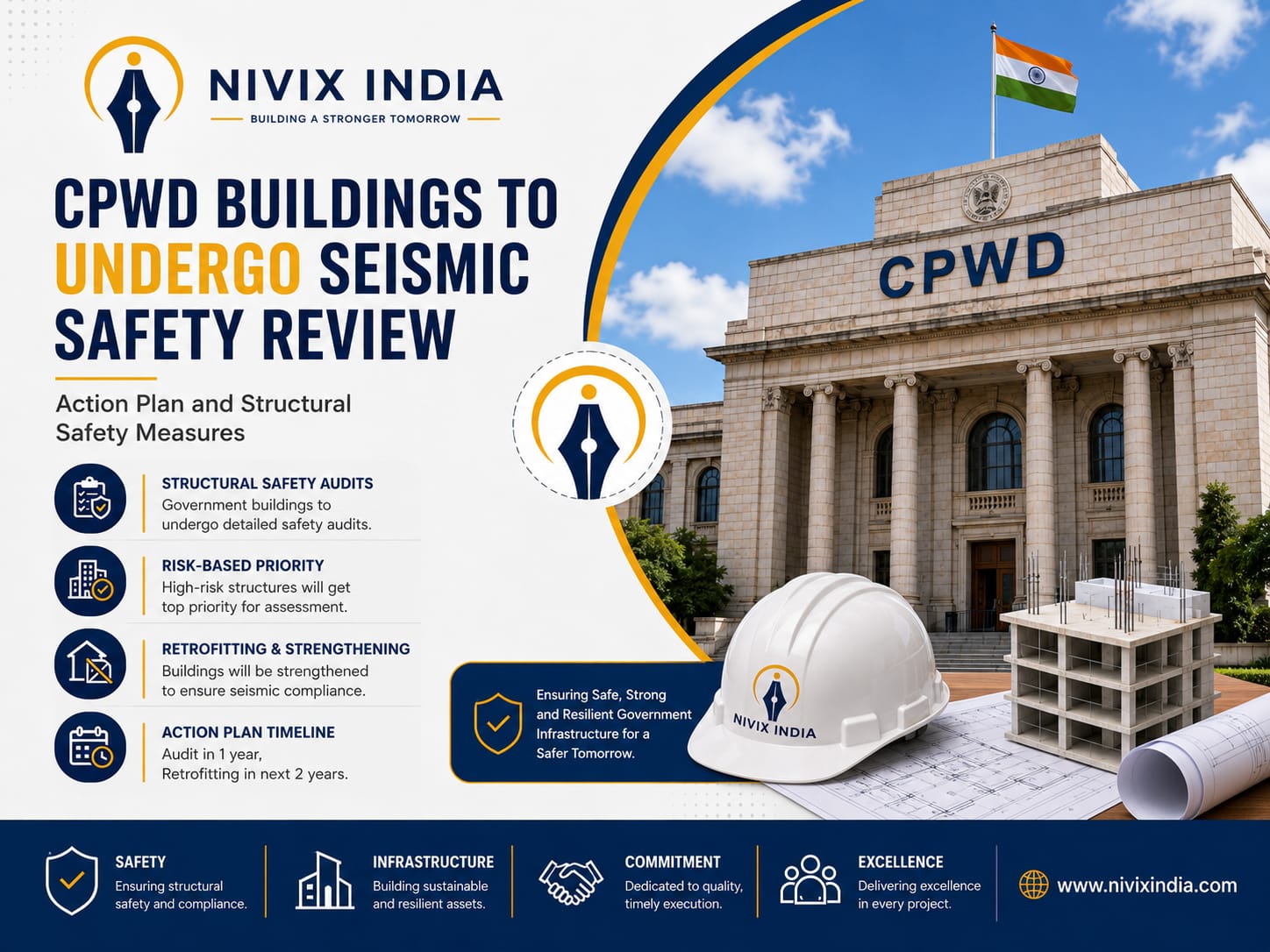
CPWD Buildings to Undergo Seismic Safety Review: Action Plan and Structural Safety Measures
The Central Public Works Department (CPWD) has renewed its focus on the seismic safety of government buildings by directing senior officials to take action on an existing roadmap for making government structures more seismically compliant.
The latest development puts renewed attention on CPWD structural safety audits, earthquakeresistant building measures, building retrofitting and structural strengthening of high-risk government buildings.
According to the information available, concerned officials have also been asked to submit an Action Taken Report (ATR) regarding the implementation of the proposed action plan.
What Is the Latest CPWD Seismic Safety Update?
The CPWD seismic safety initiative is aimed at improving the structural resilience of government buildings against earthquake-related risks.
Nearly a year after senior officials were asked to work on a roadmap for making government buildings seismically compliant, a fresh reminder has reportedly been issued by the office of the Chief Engineer (Designs and Disaster Management), CPWD.
Special Director Generals (SDGs) and Additional Director Generals (ADGs) have been asked to take necessary action and provide information regarding the progress of the proposed roadmap.
The concerned officials have reportedly been asked to submit the Action Taken Report by August 24, 2026.
Why Is CPWD Structural Safety Important?
The structural safety of government buildings is an important part of public infrastructure management.
Government buildings may be used by employees, visitors and members of the public on a daily basis. Older structures can also require detailed technical assessment to determine whether they continue to meet applicable structural and seismic safety requirements.
A proper structural safety audit can help identify:
• Structural weaknesses
• Deterioration of building components
• Earthquake-related vulnerabilities
• Areas requiring strengthening
• Buildings requiring further technical assessment
• Potential need for retrofitting or re-strengthening
Based on the findings of an assessment, appropriate engineering solutions can be considered.
CPWD Structural Safety Audit of Government Buildings
One of the key components of the earlier CPWD plan was the structural safety audit of government buildings.
Under the proposed approach, buildings would be assessed based on their structural condition and risk level. High-risk structures were expected to receive priority for detailed assessment and corrective measures.
A structural audit can provide authorities with important information about the present condition of a building and help determine whether repair, strengthening or seismic retrofitting may be required.
What Is Seismic Retrofitting?
Seismic retrofitting involves modifying or strengthening an existing structure to improve its ability to withstand earthquake-related forces.
For an existing government building, retrofitting may be considered after a professional structural assessment identifies vulnerabilities.
Depending on the building and engineering requirements, strengthening measures can include improvements to structural elements, connections or other components of the building.
The exact solution depends on factors such as the building's design, age, structural condition, location and applicable engineering requirements.
CPWD Plan for Retrofitting and Structural Strengthening
The earlier CPWD plan reportedly included two major stages:
1. Structural Safety Audit
Government buildings would first undergo assessment to identify their structural condition and risk level.
2. Retrofitting and Re-Strengthening
Buildings requiring corrective action could subsequently be considered for retrofitting or structural strengthening.
The earlier plan indicated that structural audits were to be completed within approximately one year, followed by retrofitting work over the subsequent two years.
The latest reminder highlights the importance of moving forward with the proposed roadmap and maintaining proper implementation records.
High-Risk Government Buildings May Receive Priority
A risk-based approach can help authorities prioritise buildings where structural intervention may be more urgent.
Under the earlier plan, high-risk government buildings were expected to receive greater priority for structural assessment and subsequent strengthening.
This approach can help government agencies allocate technical and financial resources more effectively while focusing first on structures requiring greater attention.
What Does This Mean for Government Infrastructure?
The renewed focus on CPWD building safety and seismic compliance could be significant for India's public infrastructure sector.
Regular structural assessments can help authorities:
• Identify potential structural risks
• Plan maintenance and repair work
• Prioritise high-risk buildings
• Improve building resilience
• Plan structural strengthening
• Improve long-term infrastructure management
For construction companies, civil contractors, structural consultants and infrastructure businesses, such developments can also create awareness about upcoming requirements related to government construction, repair, renovation, maintenance and structural strengthening projects.
Businesses interested in government procurement should regularly monitor relevant CPWD tenders, government tenders and public works opportunities through the appropriate official procurement platforms.
CPWD Tenders and Government Construction Opportunities
The CPWD is associated with a wide range of public infrastructure and building-related activities.
Companies operating in the construction and infrastructure sector may encounter opportunities related to:
• Government building construction
• Building repair and maintenance
• Civil construction
• Renovation work
• Structural strengthening
• Infrastructure development
• Electrical and mechanical works
• Maintenance contracts
• Specialised construction services
Businesses planning to participate in government procurement should ensure that they understand the applicable tender eligibility requirements, registration requirements, technical qualifications and documentation before submitting a bid.
Frequently Asked Questions
1. What is CPWD seismic safety?
CPWD seismic safety refers to measures aimed at improving the ability of government buildings under CPWD-related infrastructure management to withstand earthquake-related forces and meet applicable structural safety requirements.
2. What is a CPWD structural safety audit?
A CPWD structural safety audit is an assessment of the structural condition and safety of a government building to identify potential weaknesses, risks and requirements for repair or strengthening.
3. Why are government buildings being assessed for seismic safety?
Structural assessment can help identify vulnerabilities in existing buildings and determine whether additional strengthening, repair or seismic retrofitting may be required.
4. What is seismic retrofitting of a building?
Seismic retrofitting is the process of strengthening or modifying an existing building to improve its structural performance against earthquake-related forces.
5. Which buildings may receive priority under the CPWD plan?
According to the earlier plan described in the report, buildings identified as high-risk structures were expected to receive priority for structural safety assessment and subsequent strengthening.
6. What is an Action Taken Report (ATR)?
An Action Taken Report (ATR) provides information about the actions taken by the concerned authorities or officials in response to an instruction, decision or proposed action plan.
7. When is the CPWD Action Taken Report reportedly due?
According to the information provided, concerned officials have been asked to furnish the Action Taken Report by August 24, 2026.
8. What is the importance of structural strengthening?
Structural strengthening can improve the performance and safety of an existing building where an assessment identifies structural deficiencies or vulnerabilities.
9. Can contractors participate in CPWD infrastructure projects?
Eligible contractors and businesses can participate in relevant CPWD and government procurement opportunities subject to the applicable tender conditions, eligibility criteria, registrations and technical requirements.
10. Where can businesses find government tender opportunities?
Businesses should monitor the relevant official government procurement and tender portals and carefully review each tender's eligibility criteria and submission requirements.
Key Takeaways
CPWD seismic safety has once again become an important topic in the government infrastructure sector.
The major points include:
• CPWD has renewed attention on its seismic safety roadmap.
• Structural safety audits are an important part of the proposed approach.
• High-risk government buildings may receive priority.
• Retrofitting and structural strengthening may be required after assessment.
• Concerned officials have reportedly been asked to submit an ATR by August 24, 2026.
• The development highlights the importance of long-term government building safety and infrastructure resilience.
Conclusion
The renewed focus on CPWD seismic safety, structural audits and building retrofitting highlights the importance of maintaining safe and resilient government infrastructure.
A systematic process involving structural assessment, risk-based prioritisation, repair, seismic retrofitting and structural strengthening can help authorities address vulnerabilities in existing buildings.
For contractors, civil engineering companies, infrastructure consultants and businesses interested in government projects, developments related to CPWD construction, maintenance, renovation and structural strengthening tenders are worth monitoring.
As implementation of the roadmap progresses, further updates may provide greater clarity on the structural safety assessment and strengthening of government buildings across different locations.
Keywords
CPWD seismic safety, CPWD structural audit, CPWD building safety, CPWD structural safety audit, CPWD seismic compliance, CPWD building retrofitting, CPWD retrofitting, government building safety, government building structural audit, seismic safety India, earthquake safety government buildings, CPWD infrastructure, CPWD construction, CPWD tender, CPWD tenders 2026, government tenders, structural strengthening, government infrastructure projects
Google Business Profile Post Title
CPWD Seismic Safety Update: Structural Audits & Retrofitting Plan
GBP Short Post
CPWD has renewed its focus on the seismic safety of government buildings, with structural audits, risk-based assessment and retrofitting forming key parts of the proposed approach.
Read the complete update to understand CPWD structural audits, seismic compliance, building retrofitting and its potential impact on government infrastructure
The Central Public Works Department (CPWD) has renewed its focus on the seismic safety of government buildings by directing senior officials to take action on an existing roadmap for making government structures more seismically compliant.
The latest development puts renewed attention on CPWD structural safety audits, earthquakeresistant building measures, building retrofitting and structural strengthening of high-risk government buildings.
According to the information available, concerned officials have also been asked to submit an Action Taken Report (ATR) regarding the implementation of the proposed action plan.
What Is the Latest CPWD Seismic Safety Update?
The CPWD seismic safety initiative is aimed at improving the structural resilience of government buildings against earthquake-related risks.
Nearly a year after senior officials were asked to work on a roadmap for making government buildings seismically compliant, a fresh reminder has reportedly been issued by the office of the Chief Engineer (Designs and Disaster Management), CPWD.
Special Director Generals (SDGs) and Additional Director Generals (ADGs) have been asked to take necessary action and provide information regarding the progress of the proposed roadmap.
The concerned officials have reportedly been asked to submit the Action Taken Report by August 24, 2026.
Why Is CPWD Structural Safety Important?
The structural safety of government buildings is an important part of public infrastructure management.
Government buildings may be used by employees, visitors and members of the public on a daily basis. Older structures can also require detailed technical assessment to determine whether they continue to meet applicable structural and seismic safety requirements.
A proper structural safety audit can help identify:
• Structural weaknesses
• Deterioration of building components
• Earthquake-related vulnerabilities
• Areas requiring strengthening
• Buildings requiring further technical assessment
• Potential need for retrofitting or re-strengthening
Based on the findings of an assessment, appropriate engineering solutions can be considered.
CPWD Structural Safety Audit of Government Buildings
One of the key components of the earlier CPWD plan was the structural safety audit of government buildings.
Under the proposed approach, buildings would be assessed based on their structural condition and risk level. High-risk structures were expected to receive priority for detailed assessment and corrective measures.
A structural audit can provide authorities with important information about the present condition of a building and help determine whether repair, strengthening or seismic retrofitting may be required.
What Is Seismic Retrofitting?
Seismic retrofitting involves modifying or strengthening an existing structure to improve its ability to withstand earthquake-related forces.
For an existing government building, retrofitting may be considered after a professional structural assessment identifies vulnerabilities.
Depending on the building and engineering requirements, strengthening measures can include improvements to structural elements, connections or other components of the building.
The exact solution depends on factors such as the building's design, age, structural condition, location and applicable engineering requirements.
CPWD Plan for Retrofitting and Structural Strengthening
The earlier CPWD plan reportedly included two major stages:
1. Structural Safety Audit
Government buildings would first undergo assessment to identify their structural condition and risk level.
2. Retrofitting and Re-Strengthening
Buildings requiring corrective action could subsequently be considered for retrofitting or structural strengthening.
The earlier plan indicated that structural audits were to be completed within approximately one year, followed by retrofitting work over the subsequent two years.
The latest reminder highlights the importance of moving forward with the proposed roadmap and maintaining proper implementation records.
High-Risk Government Buildings May Receive Priority
A risk-based approach can help authorities prioritise buildings where structural intervention may be more urgent.
Under the earlier plan, high-risk government buildings were expected to receive greater priority for structural assessment and subsequent strengthening.
This approach can help government agencies allocate technical and financial resources more effectively while focusing first on structures requiring greater attention.
What Does This Mean for Government Infrastructure?
The renewed focus on CPWD building safety and seismic compliance could be significant for India's public infrastructure sector.
Regular structural assessments can help authorities:
• Identify potential structural risks
• Plan maintenance and repair work
• Prioritise high-risk buildings
• Improve building resilience
• Plan structural strengthening
• Improve long-term infrastructure management
For construction companies, civil contractors, structural consultants and infrastructure businesses, such developments can also create awareness about upcoming requirements related to government construction, repair, renovation, maintenance and structural strengthening projects.
Businesses interested in government procurement should regularly monitor relevant CPWD tenders, government tenders and public works opportunities through the appropriate official procurement platforms.
CPWD Tenders and Government Construction Opportunities
The CPWD is associated with a wide range of public infrastructure and building-related activities.
Companies operating in the construction and infrastructure sector may encounter opportunities related to:
• Government building construction
• Building repair and maintenance
• Civil construction
• Renovation work
• Structural strengthening
• Infrastructure development
• Electrical and mechanical works
• Maintenance contracts
• Specialised construction services
Businesses planning to participate in government procurement should ensure that they understand the applicable tender eligibility requirements, registration requirements, technical qualifications and documentation before submitting a bid.
Frequently Asked Questions
1. What is CPWD seismic safety?
CPWD seismic safety refers to measures aimed at improving the ability of government buildings under CPWD-related infrastructure management to withstand earthquake-related forces and meet applicable structural safety requirements.
2. What is a CPWD structural safety audit?
A CPWD structural safety audit is an assessment of the structural condition and safety of a government building to identify potential weaknesses, risks and requirements for repair or strengthening.
3. Why are government buildings being assessed for seismic safety?
Structural assessment can help identify vulnerabilities in existing buildings and determine whether additional strengthening, repair or seismic retrofitting may be required.
4. What is seismic retrofitting of a building?
Seismic retrofitting is the process of strengthening or modifying an existing building to improve its structural performance against earthquake-related forces.
5. Which buildings may receive priority under the CPWD plan?
According to the earlier plan described in the report, buildings identified as high-risk structures were expected to receive priority for structural safety assessment and subsequent strengthening.
6. What is an Action Taken Report (ATR)?
An Action Taken Report (ATR) provides information about the actions taken by the concerned authorities or officials in response to an instruction, decision or proposed action plan.
7. When is the CPWD Action Taken Report reportedly due?
According to the information provided, concerned officials have been asked to furnish the Action Taken Report by August 24, 2026.
8. What is the importance of structural strengthening?
Structural strengthening can improve the performance and safety of an existing building where an assessment identifies structural deficiencies or vulnerabilities.
9. Can contractors participate in CPWD infrastructure projects?
Eligible contractors and businesses can participate in relevant CPWD and government procurement opportunities subject to the applicable tender conditions, eligibility criteria, registrations and technical requirements.
10. Where can businesses find government tender opportunities?
Businesses should monitor the relevant official government procurement and tender portals and carefully review each tender's eligibility criteria and submission requirements.
Key Takeaways
CPWD seismic safety has once again become an important topic in the government infrastructure sector.
The major points include:
• CPWD has renewed attention on its seismic safety roadmap.
• Structural safety audits are an important part of the proposed approach.
• High-risk government buildings may receive priority.
• Retrofitting and structural strengthening may be required after assessment.
• Concerned officials have reportedly been asked to submit an ATR by August 24, 2026.
• The development highlights the importance of long-term government building safety and infrastructure resilience.
Conclusion
The renewed focus on CPWD seismic safety, structural audits and building retrofitting highlights the importance of maintaining safe and resilient government infrastructure.
A systematic process involving structural assessment, risk-based prioritisation, repair, seismic retrofitting and structural strengthening can help authorities address vulnerabilities in existing buildings.
For contractors, civil engineering companies, infrastructure consultants and businesses interested in government projects, developments related to CPWD construction, maintenance, renovation and structural strengthening tenders are worth monitoring.
As implementation of the roadmap progresses, further updates may provide greater clarity on the structural safety assessment and strengthening of government buildings across different locations.
Keywords
CPWD seismic safety, CPWD structural audit, CPWD building safety, CPWD structural safety audit, CPWD seismic compliance, CPWD building retrofitting, CPWD retrofitting, government building safety, government building structural audit, seismic safety India, earthquake safety government buildings, CPWD infrastructure, CPWD construction, CPWD tender, CPWD tenders 2026, government tenders, structural strengthening, government infrastructure projects
Google Business Profile Post Title
CPWD Seismic Safety Update: Structural Audits & Retrofitting Plan
GBP Short Post
CPWD has renewed its focus on the seismic safety of government buildings, with structural audits, risk-based assessment and retrofitting forming key parts of the proposed approach.
Read the complete update to understand CPWD structural audits, seismic compliance, building retrofitting and its potential impact on government infrastructure
TENDER ASSISTANCE
Need Help With Tender Filing?
Get expert assistance for tender search, documentation, eligibility checks and bid submission.
