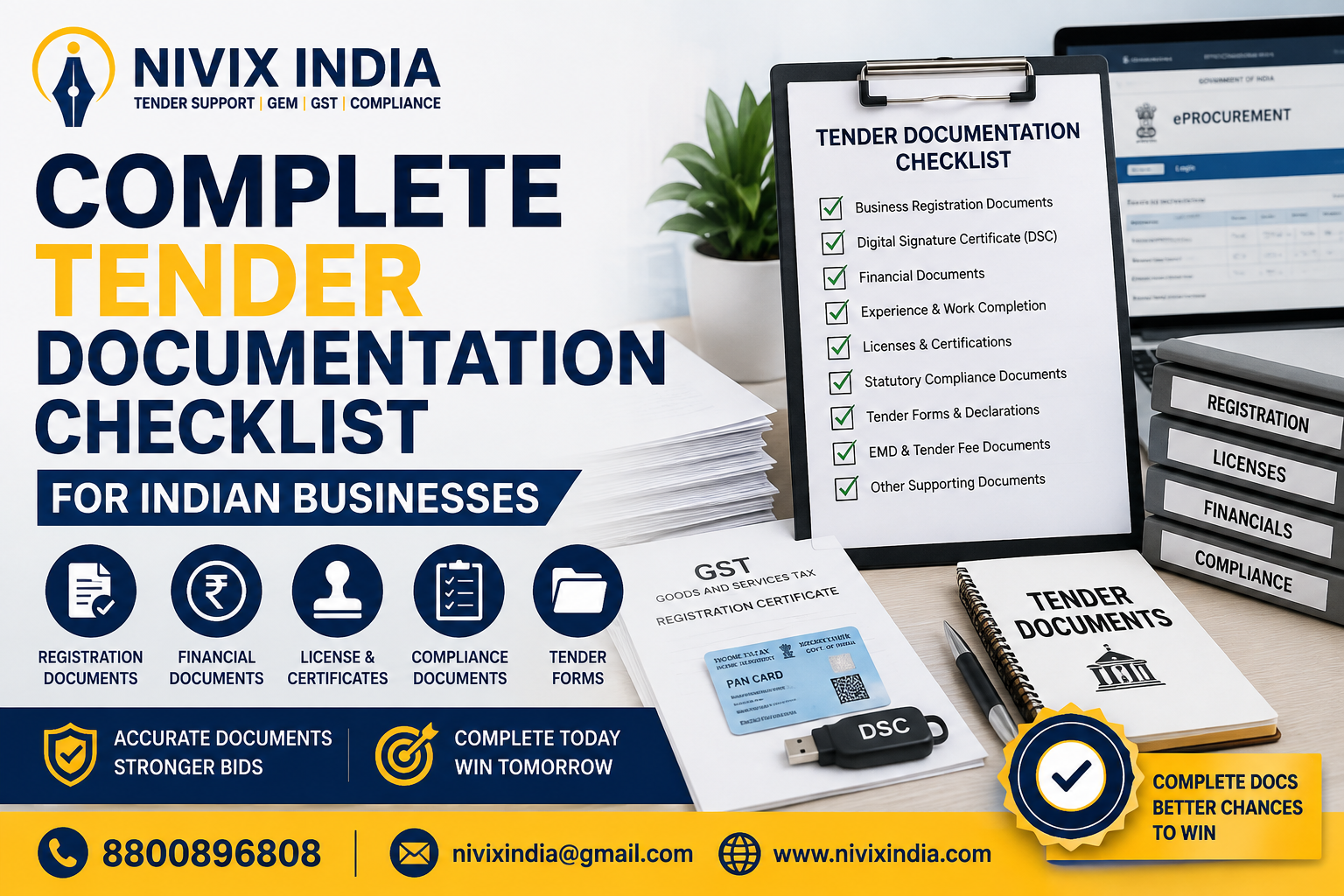
Introduction
Winning a government tender starts long before the bid is submitted. Whether you are participating in CPWD, Railway, MES, State PWD, PSU, or Gem tenders, your documentation must be accurate, updated, and properly organized.
Many first-time bidders focus only on pricing and technical eligibility, but experienced contractors know that documentation compliance is equally important. Even a competitive bid can be rejected if mandatory documents are missing, expired, unsigned, or uploaded incorrectly.
At Nivix India, we regularly assist businesses with tender documentation, eligibility verification, and complete bid filing support. A structured documentation checklist helps reduce errors and improves the chances of successful bid acceptance.
Why Tender Documentation Matters
Tender authorities evaluate documents to verify:
• Legal identity of the business
• Financial capability
• Technical experience
• Tax and statutory compliance
• Authorized signatory details
• Past performance and eligibility conditions
Basic Business Registration Documents
• Keep these documents ready in scanned PDF format:
Document
PAN Card
GST Registration Certificate
Certificate of Incorporation / Partnership Deed / LLP Agreement / Proprietorship proof
Udyam (MSME) Certificate
Shop & Establishment / Trade License (if applicable)
2. Digital Signature Certificate (DSC)
Most government e-procurement portals require a Class 3 Digital Signature Certificate for bid submission.
Checklist:
• Valid and unexpired DSC
• Registered on the tender portal
• Authorized signatory mapped correctly
• Token drivers installed and tested before submission day
3. Financial Documents
Authorities commonly ask for:
• Audited Balance Sheets (last 3 financial years)
• Profit & Loss Statements
• CA-certified Turnover Certificate
• Net Worth Certificate (where required)
• Bank Solvency Certificate (if specified)
• ITR acknowledgements
4. Experience & Work Completion Documents
For construction, electrical, railway, and infrastructure tenders, these are critical:
• Work Orders
• Agreement Copies
• Completion Certificates
• Performance Certificates
• Client-issued satisfactory completion letters
• Running bill/work progress certificates (if ongoing work is allowed)
5. Technical & License Documents
Depending on the tender category:
• Electrical Contractor License
• CPWD Registration
• MES Registration
• Railway Vendor/Contractor Registration
• Factory License
• BIS/ISI certifications
• OEM authorization
• Product test reports
• ISO certificates (ISO 9001, ISO 14001, ISO 45001, etc.) 6. Statutory Compliance Documents
Keep updated copies of:
• GST Returns (GSTR-3B / GSTR-1 if requested)
• PAN
• EPF Registration & latest challans
• ESIC Registration & latest challans
• Labour License (where applicable)
• Professional Tax registration (state-specific)
• No dues / statutory compliance declarations if required
7. Mandatory Tender Forms
Never ignore tender-specific formats such as:
• Bid Submission Form
• Letter of Bid
• Undertaking / Declaration
• Non-Blacklisting Certificate
• Integrity Pact (if applicable)
• Power of Attorney / Authorization Letter
• Affidavits prescribed in the tender document
• EMD exemption declaration (for eligible MSMEs where allowed)
Common Upload Mistakes to Avoid
• Expired GST, DSC, or license documents
• Unsigned declarations
• Wrong file names
• Blurry scans
• Password-protected PDFs
• Uploading another firm’s document by mistake
• Mismatch in address or business name
• Missing page numbers in multi-page certificates
• Uploading financial documents without CA certification where required
Conclusion
• A well-prepared documentation file is one of the strongest advantages in government tender bidding. Most technical rejections happen due to documentation gaps, not pricing issues. Indian businesses should maintain a ready-to-use digital tender folder containing legal, financial, technical, and statutory documents so that bids can be submitted quickly and accurately whenever a suitable opportunity appears.
• At Nivix India, we help businesses with tender documentation review, eligibility verification, GeM registration, railway tender support, CPWD/MES documentation, and complete government tender filing assistance.
Winning a government tender starts long before the bid is submitted. Whether you are participating in CPWD, Railway, MES, State PWD, PSU, or Gem tenders, your documentation must be accurate, updated, and properly organized.
Many first-time bidders focus only on pricing and technical eligibility, but experienced contractors know that documentation compliance is equally important. Even a competitive bid can be rejected if mandatory documents are missing, expired, unsigned, or uploaded incorrectly.
At Nivix India, we regularly assist businesses with tender documentation, eligibility verification, and complete bid filing support. A structured documentation checklist helps reduce errors and improves the chances of successful bid acceptance.
Why Tender Documentation Matters
Tender authorities evaluate documents to verify:
• Legal identity of the business
• Financial capability
• Technical experience
• Tax and statutory compliance
• Authorized signatory details
• Past performance and eligibility conditions
Basic Business Registration Documents
• Keep these documents ready in scanned PDF format:
Document
PAN Card
GST Registration Certificate
Certificate of Incorporation / Partnership Deed / LLP Agreement / Proprietorship proof
Udyam (MSME) Certificate
Shop & Establishment / Trade License (if applicable)
2. Digital Signature Certificate (DSC)
Most government e-procurement portals require a Class 3 Digital Signature Certificate for bid submission.
Checklist:
• Valid and unexpired DSC
• Registered on the tender portal
• Authorized signatory mapped correctly
• Token drivers installed and tested before submission day
3. Financial Documents
Authorities commonly ask for:
• Audited Balance Sheets (last 3 financial years)
• Profit & Loss Statements
• CA-certified Turnover Certificate
• Net Worth Certificate (where required)
• Bank Solvency Certificate (if specified)
• ITR acknowledgements
4. Experience & Work Completion Documents
For construction, electrical, railway, and infrastructure tenders, these are critical:
• Work Orders
• Agreement Copies
• Completion Certificates
• Performance Certificates
• Client-issued satisfactory completion letters
• Running bill/work progress certificates (if ongoing work is allowed)
5. Technical & License Documents
Depending on the tender category:
• Electrical Contractor License
• CPWD Registration
• MES Registration
• Railway Vendor/Contractor Registration
• Factory License
• BIS/ISI certifications
• OEM authorization
• Product test reports
• ISO certificates (ISO 9001, ISO 14001, ISO 45001, etc.) 6. Statutory Compliance Documents
Keep updated copies of:
• GST Returns (GSTR-3B / GSTR-1 if requested)
• PAN
• EPF Registration & latest challans
• ESIC Registration & latest challans
• Labour License (where applicable)
• Professional Tax registration (state-specific)
• No dues / statutory compliance declarations if required
7. Mandatory Tender Forms
Never ignore tender-specific formats such as:
• Bid Submission Form
• Letter of Bid
• Undertaking / Declaration
• Non-Blacklisting Certificate
• Integrity Pact (if applicable)
• Power of Attorney / Authorization Letter
• Affidavits prescribed in the tender document
• EMD exemption declaration (for eligible MSMEs where allowed)
Common Upload Mistakes to Avoid
• Expired GST, DSC, or license documents
• Unsigned declarations
• Wrong file names
• Blurry scans
• Password-protected PDFs
• Uploading another firm’s document by mistake
• Mismatch in address or business name
• Missing page numbers in multi-page certificates
• Uploading financial documents without CA certification where required
Conclusion
• A well-prepared documentation file is one of the strongest advantages in government tender bidding. Most technical rejections happen due to documentation gaps, not pricing issues. Indian businesses should maintain a ready-to-use digital tender folder containing legal, financial, technical, and statutory documents so that bids can be submitted quickly and accurately whenever a suitable opportunity appears.
• At Nivix India, we help businesses with tender documentation review, eligibility verification, GeM registration, railway tender support, CPWD/MES documentation, and complete government tender filing assistance.
TENDER ASSISTANCE
Need Help With Tender Filing?
Get expert assistance for tender search, documentation, eligibility checks and bid submission.
